
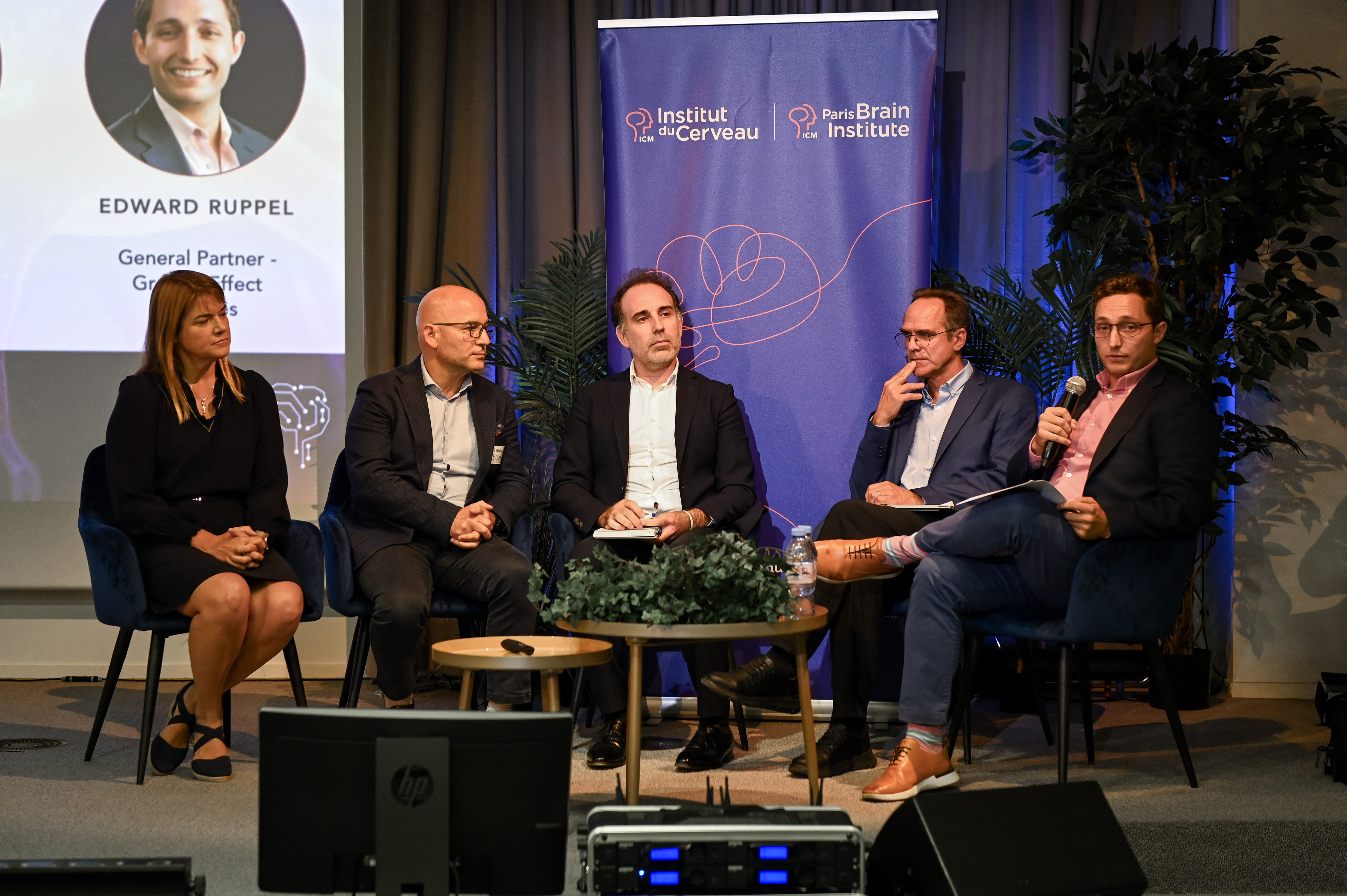
BrainTech Alliance, Paris Brain Institute, September 15, 2026##
Speakers: Pr Jean-Christophe Corvol (Neurologist, Paris Brain Institute; Coordinator, NS-PARK), Pr Emrah Düzel (Co-founder and Chief Medical Officer, Neotiv), Thomas Trailov (VP Partnerships & Strategy, Healthcare, Air Liquide), Amy Kruse (General Partner, Satori Neuro) Facilitator: Edward Ruppel (General Partner, Ground Effect Ventures)
The central question
Edward Ruppel started by reminding the room that everyone here is a patient, or will be, and so are our families. Then he put up some uncomfortable history. Cochlear implants, spinal cord stimulation, deep brain stimulation and sacral neuromodulation have all been around for decades. None of them reaches more than a small share of the patients who could use them. Magnetoencephalography, for all its scientific value, is still rare worldwide.
So his question was simple. Can data and AI help with the things that actually limit adoption: finding patients, convincing referring doctors, proving value to whoever pays? Or will startups just reach the same wall sooner, having spent more money getting there?
Data helps, up to a point
The panel agreed that data matters, but each speaker brought a different lens.
The investor view: Amy Kruse described moving from skepticism to genuine hope. Datasets are reaching meaningful scale, teams increasingly know what to do with them, and companies are building foundation models, both general-purpose and disease-specific.
The founder view: Emrah Düzel distinguished two needs. As a researcher, he wants broad multimodal data across countries. As a founder, he needs data from specific cohorts tied to a defined use case, such as preclinical identification, disease monitoring, outcome measurement or clinical trials. For startups, the hardest part is choosing the right use case and then reaching the right cohort at the right time.
The corporate view: Thomas Trailov noted that Air Liquide has spent a decade using data to change the economics of care with health authorities, with sleep as an earlier success. He sees the volume and quality of data now entering neuro as a strong signal that the field can scale.
The clinical research view: Jean-Christophe Corvol was the most cautious. Size isn't enough: the data has to be deep, longitudinal and multimodal. And even then, neuro's hard problems don't go away. Patients are heterogeneous, diagnosis comes late, diseases progress slowly and endpoints are noisy. AI might get you from data to a hypothesis faster, he said, but proving the hypothesis still means going back to patients.
NS-PARK and the institutional problem
NS-PARK was described as a rare asset: a standardized, longitudinal, nationwide Parkinson's dataset collected in routine care rather than only in trials. Asked whether it has been as predictive as hoped, the answer was: not yet.
Pr Corvol described collecting the data as a daily fight involving three groups:
- Patients are generally willing to share.
- Physicians are harder to engage consistently.
- Institutions are the hardest, because they must collectively agree to share data for the common good.
For a startup that wants to build on the dataset, the institutions are the gatekeepers. They act as custodians rather than owners, and without a working process, even genuine goodwill doesn't get anyone very far. He was clear that regulation isn't the main obstacle. Consent frameworks and transparency portals already exist. What's missing is the will, a strategy, and a process simple enough to use.
Neotiv's two products
Neotiv's starting point was a memory paradigm developed on 7T MRI, which the team turned into a smartphone test patients take alone at home. It still tracks gold-standard biomarkers. Pr Düzel said going commercial forced a kind of planning that academic research never did: thinking about what the tool would need to be in five or six years.
The company built two products in parallel from the start:
- A regulated medical product, placed in physicians' hands for diagnostic use.
- A lighter research product, which generates data in cohorts and pharma trials, where it serves as an exploratory outcome.
Investors weren't convinced and asked why the company wouldn't focus on one. The founders' answer was that the medical product alone couldn't generate the data they needed. Looking back, it worked: the two products now inform each other. He called it probably the hardest decision a startup makes.
He also talked about Germany's DiGA reimbursement pathway. It isn't yet open to diagnostic tools, and he'd like it to be, ideally with equivalents across Europe. The recent rule changes demand ongoing evidence on usage, drop-off and benefit, with prices tied to outcomes. That's harder on startups, he acknowledged, but without it doctors and payers won't trust digital health tools.
What Air Liquide sees at home
Air Liquide looks after advanced Parkinson's patients at home, where treatment can mean a mix of devices, sensors and injectable drugs. All of that home care produces a huge longitudinal record of how patients behave, use their devices and experience side effects. Until recently, much of it was messy data that nobody could do much with, like text messages and phone calls. Thomas Trailov said AI tools have changed that dramatically.
He sees two promising directions:
- Simple, non-invasive sensors, following the path diabetes monitoring took with continuous glucose monitors.
- Short-term predictive models of disease evolution built on daily home data, rather than long-range projections.
When Air Liquide partners with startups, clinical outcomes aren't the only thing it cares about. How care is delivered and paid for matters just as much, especially as European health authorities warm to outcome-based payment. His advice was to be honest about what you bring. Some past partnerships went badly because startups reshaped their pitch for the meeting and then drifted away from the problem they were actually solving.
What investors want to see
Amy Kruse sees two kinds of founders. Some claim a proprietary angle on shared datasets, such as biobank imaging or proteomics, and the diligence question is what's actually theirs. Others ignore shared data entirely and collect their own continuous, multimodal data, sometimes building foundation models on top. In her experience, European founders lean toward the science-heavy end, while US founders are more willing to simply record people at scale and see what emerges.
The mistake she sees most is a plan that depends on four miracles in a row: find the biomarker, get it implemented, persuade clinicians to use it, and get someone to pay. Her reaction to those plans is roughly "good luck with that." She is far more impressed by a proof of concept in a small cohort, hospital partnerships already in place, and a care pathway that makes sense. Clinical data is what counts. Raising institutional venture money on preclinical results alone is very hard right now.
Early on, she spends more time assessing the team than the science, because many clinical questions can't be answered yet anyway. A plan where "my postdoc will run it" is a warning sign. She wants to know whether an academic founder understands what they don't know, genuinely wants to become a CEO, and will recognize when to bring in experienced operators. Where possible, grants and other non-dilutive funding are the best way to reach proof of concept. She also pointed out that nobody has to jump straight from a lab result to a venture-backed company. Intermediate structures such as focused research organizations can bridge the gap.
Where the energy is
Amy cautioned that a handful of huge brain-computer interface rounds make the neurotech market look hotter than it is: take them out and much of the boom disappears. What excites her in the near term is non-invasive neuromodulation. It can target specific circuits and is portable enough to reach patients far from academic centers, even from a van. She mentioned single-day TMS treatment for depression, with durable results, as an example.
Wellness and clinical care are converging
The panel described two movements happening at once: clinical tools taking on wellness features, and wellness products moving toward clinical use.
Consumer wearables show the current gap. They can tell you that you slept badly but not fix it. Traction will come when insight is paired with a real opportunity to improve. Pr Düzel argued the two worlds can't be fully separated. A remote assessment tool spends a lot of time with patients, so their anxiety, wellbeing and brain health goals matter too. Neotiv is now working on improving patient-doctor communication through its platform. As he put it, being a wellness company is easier, but diagnostics and wellness may need to come together.
An audience member raised a different concern: could some neuromodulation or wellness technologies end up requiring long-term use to sustain their benefits? The panel did not reach a single answer. Instead, the speakers approached the question from three different angles:
Amy Kruse pointed to treatments like single-day TMS that may not require chronic use, and said she is not interested in technologies designed to create chronic users.
Pr Corvol expected behavior to self-regulate over time, as excess of any health behavior eventually shows adverse effects.
Thomas Trailov noted that in his patient population the real problem is the opposite: non-adherence. Engagement tools could help patients stay on treatments they need.
Money, time and geography
Europe offers a strong environment for neuro research, but several speakers argued that commercialization and fundraising still pull neurotech companies toward the US. This becomes particularly visible around Series A, when many European founders establish a US entity or presence. Edward Ruppel noted that Ground Effect invests globally and does not require companies to relocate.
The challenge for a Europe-first strategy is reimbursement and access to capital. Until European markets offer clearer commercial pathways, founders may find it harder to convince investors to prioritize Europe over the US. Amy Kruse noted that even a temporary US presence can accelerate fundraising, which is why some European founders spend significant time in Boston or San Francisco. She also pointed to Texas, particularly Austin, Dallas and Houston, as an emerging neurotech hub.
Last words to founders
The session closed with one piece of advice from each speaker:
-
Pr Emrah Düzel: focus on the problem, not the technology. Knowing that early Alzheimer's is diagnosed too late is not enough, the real problem is understanding why.
-
Thomas Trailov: be honest and consistent with corporate partners. Openness between corporates and startups has grown, but only after many failures. Don't reshape your core problem to fit a meeting.
-
Pr Jean-Christophe Corvol: know who will pay. A business where patients pay monthly is completely different from one where physicians pay. Physicians already overwhelmed by sensor data won't pay for more of it.
-
Edward Ruppel: stay on the critical path. At the end, only intellectual property and clinical data hold value. Spend as little as possible, prove it in real patients and get there fast.
Open questions
- Can data and AI measurably raise adoption rates for neurotechnologies, or mainly speed up development?
- How can institutions create simple, operational processes for sharing datasets like NS-PARK with startups?
- Will reimbursement pathways such as DiGA open to diagnostics, and can similar pathways emerge across Europe?
- How can underexploited home-care data be turned into better care delivery and payment models?
- What financing structures best match neurotech's long timelines?
- What would it take for Europe-first commercialization strategies to become viable?