
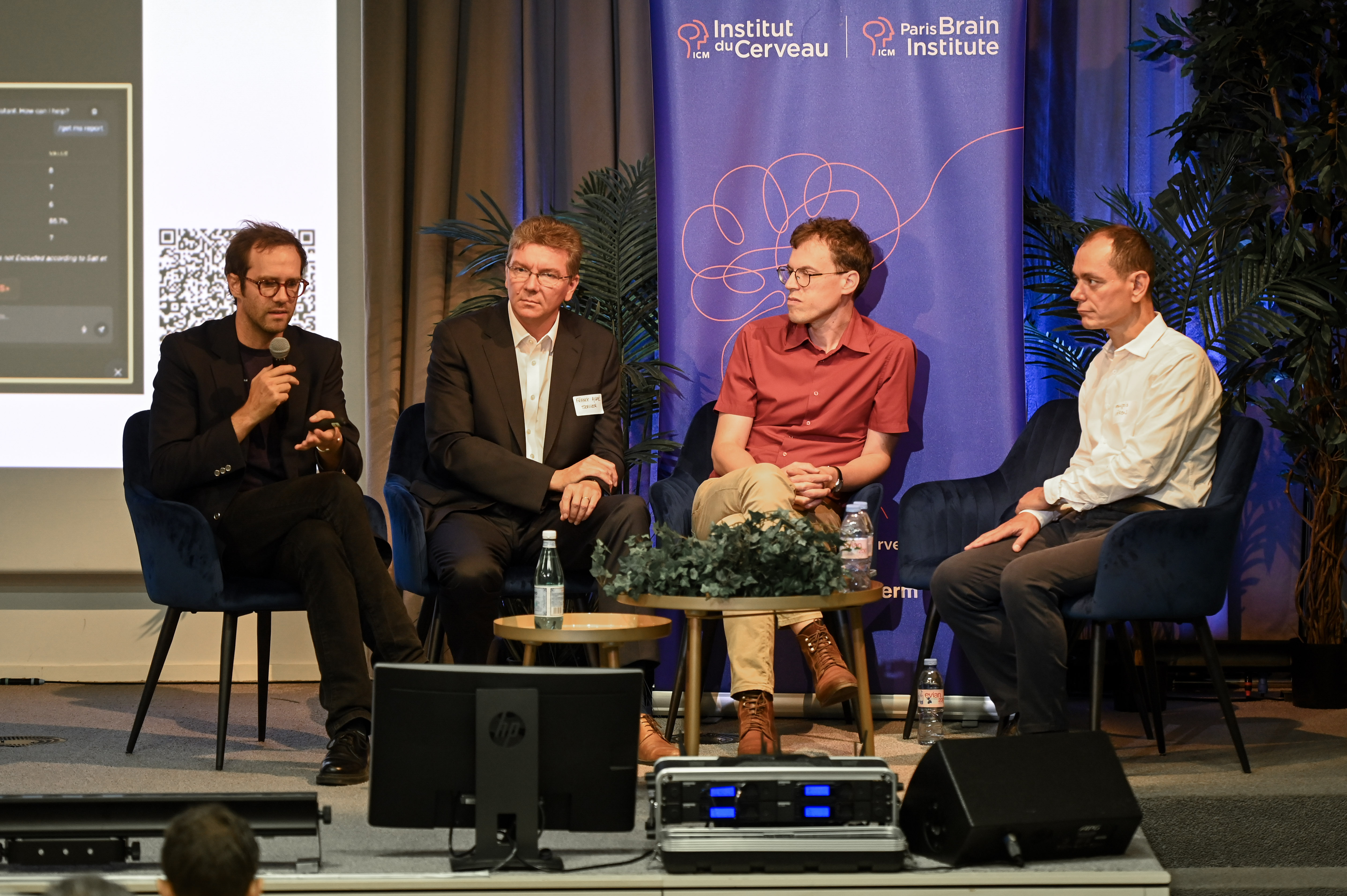
BrainTech Alliance, Paris Brain Institute, September 15, 2026##
Speakers: Pr Franck Bielle (Neuropathology, Paris Brain Institute), Franck Augé (Director R&D Search & Evaluation, AI & Digital Technologies, Servier), Paul Hérent (Co-founder and Chief Medical Officer, Raidium) Facilitator: François Véron (Managing Partner, Newfund)
The central question The path from biomarker discovery to clinical product is long and most candidates never reach the end. A typical biomarker starts in a single-center retrospective cohort. It then has to be reproduced across centers with different acquisition protocols, cleared by regulators, given a business model and integrated into clinical workflows. The session went through each of these stages and looked at what data and AI can change along the way.
Start with the scientific question
Discussing "biomarkers" only makes sense once their type and purpose are specified.
Purposes: diagnostic, prognostic and predictive biomarkers have different data requirements, even within the same disease. Modalities: physiological and clinical biomarkers (blood tests, imaging), molecular biomarkers (genomics, transcriptomics, proteomics) and digital biomarkers.
Digital biomarkers allow continuous measurement. Most molecular and physiological markers capture a single point in time. For the panel, the scientific question comes first and a good dataset is the one that answers it. In practice, finding that dataset is still difficult. There is no simple directory, and the data and the analytical method have to be chosen together.
Servier added the rare disease angle. Cohorts are small and methods that work for large prevalent diseases such as Alzheimer's often don't transfer. Servier therefore looks for external partners who bring both the technology and the dataset. Internal data can enrich these partner models but is rarely enough on its own.
Global data sharing in practice: the Heidelberg methylation classifier
Brain tumor diagnosis provided a concrete example. When microscopy and sequencing are not enough to settle a diagnosis, DNA methylation profiling is used as a second-line tool, in line with WHO recommendations.
Hospitals upload microarray data to a web portal hosted by Heidelberg University. The classifier returns a confidence score for each tumor type, which the clinician interprets together with other evidence. A US classifier at the NCI is used as a fallback. Hundreds of hospitals around the world now contribute data. More data leads to better versions of the classifier, which in turn detect rarer subtypes. No governance body imposed standardization. It came from the fact that all contributors use the same instrument platform.
The model has its limits. The classifier is a black box and doesn't explain its outputs, so results have to be validated with orthogonal data. The portal is labeled for research use only and not for diagnosis, which puts its routine clinical use in a regulatory gray zone.
The system works because people agreed to share and because a single platform imposed de facto standards. Governance came after practice.
Radiology: from narrow models to foundation models
According to Paul Hérent, radiology is the specialty with the longest experience of clinical AI, about ten years.
First-generation limits
Early systems relied on supervised learning, with one model trained per task. This works for simple binary questions such as fracture detection but doesn't scale to multiparametric imaging. MS assessment, for example, combines several MRI sequences (FLAIR, diffusion, gadolinium enhancement). Narrow tools have also been hard to sustain economically and that market is consolidating.
What foundation models change
Models that learn anatomy across sequences and organs make multiparametric MRI analysis possible. They also allow whole-body analysis, for example tracking metastases in all organs at once. Product consequence. Radiologists will not pay for a thousand narrow tools, each cleared separately. The realistic model is a single product with one user experience and many built-in capabilities. Raidium is building an AI-native version of the PACS viewer, the core software in radiology, which has barely changed in twenty years.
Data partnerships followed the same logic. Partner hospitals agreed to share large datasets because they got a better product in return. For them, it was a matter of concrete return on investment more than altruism.
Interpretability and clinical trust: the central vein sign in MS
The MS central vein sign shows how an imaging biomarker gains clinical trust. A newer MRI sequence detects iron, which makes vessels visible. The sign itself, a vein at the center of an MS lesion, corresponds directly to what histology shows, with immune cells gathering around vessels. The biomarker was discovered at high resolution on 7T MRI and then validated through correlation studies at 3T, the field strength available in routine care.
Because the imaging feature matches a known pathological mechanism, clinicians understand why it works. This mechanistic link could also allow the sign to be used for prognosis as well as diagnosis.
The practical road to product
Several practical requirements were discussed.
- Reproducibility across centers. It remains the first major hurdle once a biomarker leaves its original cohort.
- A validation bar that depends on intended use. Biomarkers used for clinical decisions, trial enrollment or as trial endpoints need to be discussed with and validated by health authorities before use. Research-only uses such as population stratification face a lower bar.
- Sample logistics. When the sample is hard to collect, multi-center trials become impractical. Blood-based biomarkers have a major practical advantage here.
Working with pharma
Franck Augé gave startups a concrete piece of advice. Before any outreach, read the pharma company's partnering page. Disease areas, modalities and technology needs are listed publicly and a misaligned pitch wastes everyone's time. The first meeting should then position the startup's technology within a specific area of need. He also noted that startup solutions and pharma priorities have become more aligned in recent years.
The chicken-and-egg problem: biomarkers and therapeutics
An investor in the audience raised a difficult point. Glioblastoma has seen almost no treatment progress in twenty years, despite large amounts of omics data. Biomarkers without matching therapeutics have limited clinical value, yet therapeutics need biomarkers to be developed.
The panel's answer was cautiously optimistic. AI-driven biotechs are entering the brain tumor field with new approaches to target identification. The idea is to develop biomarkers alongside target discovery instead of separately. New drug classes also create new biomarker needs. With immunotherapy came pseudoprogression, where apparent tumor growth actually means the treatment is working. This led to new response criteria, including iRANO for brain tumors.
Closing: toward systems biology The session ended on a broader shift. Twenty years of omics have mapped mutations and signaling pathways, but the linear gene-pathway-target model oversimplifies biology. The panelists called for methods that allow AI to model biological systems as a whole. The same applies to the brain. Answering an audience question on digital biomarkers, the panel said the field should move beyond disease silos toward a global understanding of how the brain works, from which biomarkers would then be derived. A biomarker can be clinically useful without full mechanistic understanding, but a deeper understanding makes it more powerful.
Open questions
- How can biomarkers validated in one center be reproduced reliably across heterogeneous acquisition protocols?
- Can the Heidelberg model of de facto standardization be replicated in other modalities, and how should governance catch up?
- How can black-box classifiers be made interpretable enough for routine diagnostic use?
- What business models make platform-based clinical AI sustainable for startups?
- How can biomarker development be tied more closely to therapeutic target discovery?
- What methodologies will allow AI to support a truly systemic view of disease biology?